5 posts tagged with "NLnet"

NLnet Foundation funding

View All Tags

Peer-to-Peer Chelys Tool Sharing

· 8 min read
Fares Abawi
TeXlyre author & maintainer
Part of the NGI0 Core roadmap

This post reports on Task 3 of TeXlyre's NGI0 Commons grant. For the full project roadmap, see TeXlyre joins NGI0 Commons.

Chelys tools can now be shared with collaborators over WebRTC. A service running on one user's machine can be exposed to another TeXlyre instance in the same collaborative project while the tool remains local to its host. TeXlyre can therefore interact with both local and remote providers through the same editor-side route, whereas Chelys handles the relay between a remote connection and the recipe's local endpoint, bridging WebRTC with WebSocket-connected recipes.

Background

In Task 2, we introduced support for connecting TeXlyre to local language servers over LSP through WebSocket endpoints. This is functional when TeXlyre and Chelys are running on the same machine or when the WebSocket endpoint is made public. However, the local endpoint cannot be accessed directly by other collaborators in the project when neither condition is fulfilled.

TeXlyre already uses Yjs over WebRTC for peer-to-peer project collaboration. External tools, however, follow a different communication pattern from document synchronization. Requests need to reach a specific provider, after which responses must return to the originating client. Additionally, larger messages may need to be split and reconstructed during transport. In this task, we therefore add a separate service for external tool transport. This involves the creation of a shared WebRTC and WebSocket wrapper for discovery, framing, and bidirectional communication specific to such tools, while the existing collaboration infrastructure for peer coordination remains unchanged.

The work spans two repositories. Each link below shows the full diff for that repository's contribution to this task.

  • chelys: the native WebRTC service bridge, recipe relay, and remote provider lifecycle.
  • texlyre: service framing, WebRTC and WebSocket transports, provider discovery, and project-level tool sharing.

Milestone 3a: Service serialization and transport

Local and shared external tool providers use the same service transport abstraction. Messages can contain text or binary data and can exceed the size suitable for a single transport message, as is also the case with Yjs updates. TeXlyre therefore splits larger payloads into bounded frames, transmits them in sequence, and reconstructs the original message at the receiving end. Integrations above this layer observe only the resulting message stream and remain agnostic to the transport.

The transport itself differs depending on where the provider is located. Local providers communicate over WebSocket, whereas remote providers use a WebRTC data channel. On the WebRTC side, the service channel uses SCTP over DTLS for ordered and reliable message delivery, while TeXlyre's service framing operates above this transport layer to handle application-level payload sizes and reconstruction, splitting data messages into 16 KiB chunks.

Service serialization and transport between a requesting TeXlyre instance and a shared provider host

Yjs and awareness carry only discovery and peer coordination, while framed tool payloads travel over a separate ordered WebRTC data channel and are reassembled at the receiving end.

Yjs and awareness states are used separately to announce available services and coordinate the peers involved in establishing a connection. Tool payloads, including files, commands, and responses, do not pass through the Yjs document synchronization stream. This keeps service communication independent from project synchronization while allowing both to use the same peer-to-peer collaboration infrastructure.

Milestone 3b: WebRTC relay for remote tool access

In Milestone 3a, we built the transport structure needed to reach a remote provider, while in Milestone 3b, we make an existing Chelys service (backend tool) available through that transport. The recipe continues to expose the same local WebSocket endpoint used when TeXlyre and Chelys run on the same machine. For remote access, however, Chelys exposes that service through WebRTC and relays messages between the remote connection and the recipe's local WebSocket endpoint.

Chelys relaying a WebRTC service connection to a recipe's local WebSocket endpoint

The remote instance connects over WebRTC to Chelys on the host machine, which forwards service messages to the recipe's unchanged localhost WebSocket endpoint.

The collaboration state announces which services, together with their providers, a host makes possible to share. A remote TeXlyre instance can then register a compatible shared provider alongside its local providers, while the corresponding tool remains attached only to Chelys on the host machine. Provider availability follows the host service: if the recipe is stopped or the host leaves the collaboration session, the shared provider is removed and its corresponding service connection is closed.

For example, Alice can run ltex-ls-plus through Chelys and expose it to a collaborative project. Bob's TeXlyre instance can then register and use that provider as if it were locally available, while Chelys transparently relays its requests to Alice's local ltex-ls-plus endpoint. If Alice keeps her Chelys instance running while closing TeXlyre, Bob can still connect to language server and typesetter services provided by Alice. Alice and Bob only need to be simultaneously present when the provider configuration is initially announced through the collaboration state.

WebRTC connection establishment still relies on the configured signaling infrastructure. However, this is only used to establish the peer connection and does not require the corresponding tool's WebSocket connection to be forwarded or made publicly available across the network in order to be reachable.

The same relay mechanism is also used by the external typesetters introduced in Task 5. Shared SILE or TeX Live providers can therefore transfer synchronized project files, compile requests, logs, and generated output through the same service connection without modifying the typesetter protocol.

Walkthrough: sharing a local typesetter with a collaborator

The following steps walk through exposing a Chelys typesetter to a collaborator, using the SILE recipe as the example provider. Alice hosts the typesetter and Bob compiles against it from another TeXlyre instance.

  1. On Alice's machine, install Chelys and pair it with her TeXlyre identity, following the walkthrough in the Task 2 report.

  2. In Chelys, open Browse recipes, add the SILE recipe, and install it as a Docker container (click the dropdown and choose ghcr.io... to download a pre-built Docker image instead for a quicker install).

    Chelys recipe browser with the SILE typesetter recipe added and installing in Docker mode

  3. Before starting the service, switch its transport from the local WebSocket endpoint to a WebRTC room. The transport is resolved when the service starts, so a running service has to be stopped and started again for a change to take effect.

    Chelys share options for the SILE recipe with the transport set to a WebRTC room instead of the local WebSocket endpoint

  4. Click Run. Chelys starts the SILE backend, joins the configured room, and relays the room's service messages to the recipe's local endpoint.

  5. In TeXlyre, Alice opens a SILE project (download example and upload it to TeXlyre SILE project), selects the shared services to offer in it, and sends the collaboration link to Bob.

    TeXlyre project sharing panel listing Alice's running Chelys services with per-project selection

  6. Bob opens the shared project. SILE appears in his compiler list next to the built-in browser compilers, marked as hosted by Alice. Clicking use in the approval toast allows the tools shared by Alice to be used for current and other projects where applicable.
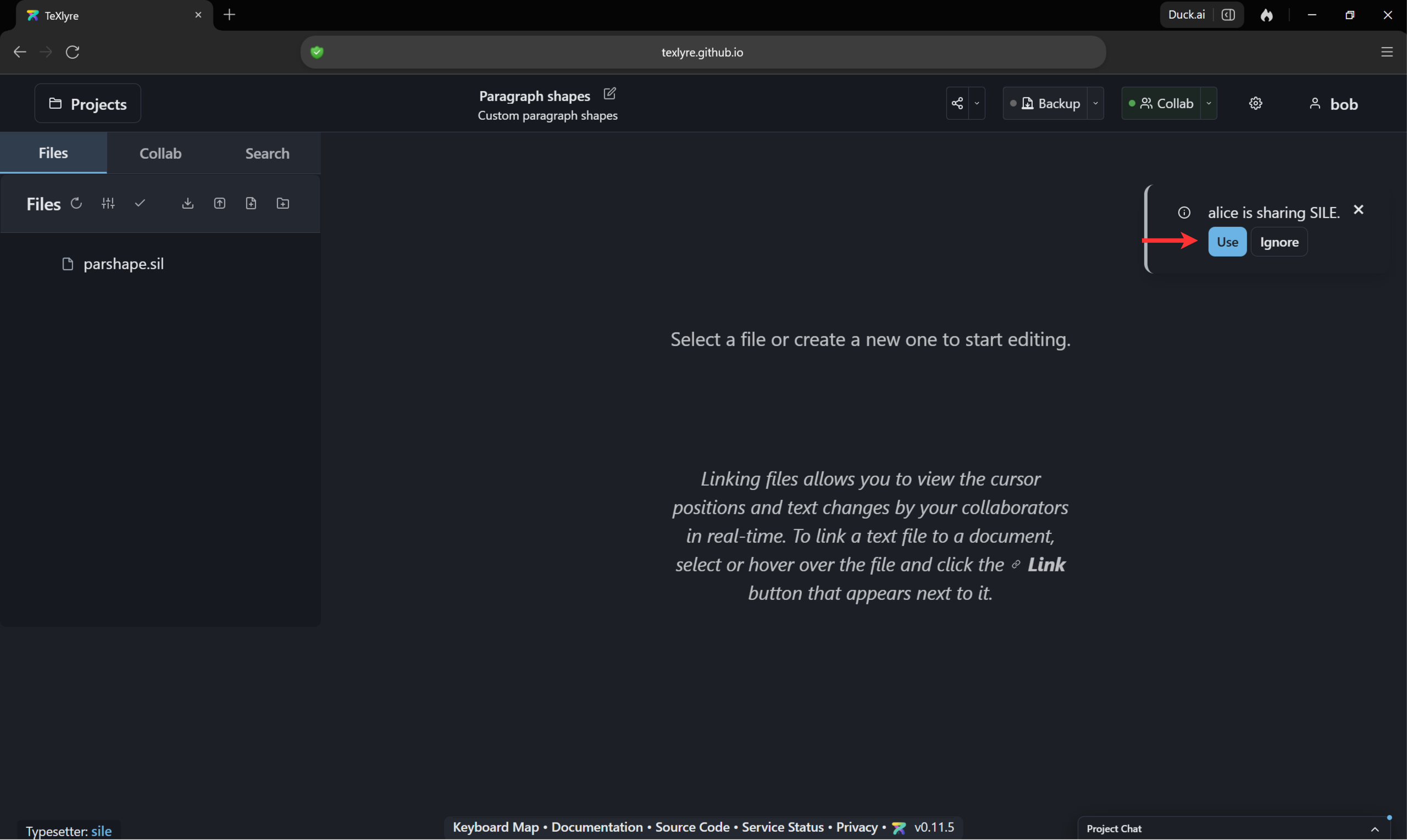
    TeXlyre on Bob's instance showing the 'Use' toast to begin using Alice's SILE typestting compiler

  7. Bob compiles parshape.sil. The project files are synchronized to Alice's machine over the service channel, SILE runs there, and the PDF and log are returned to Bob's preview pane.

    TeXlyre on Bob's instance showing the PDF produced by Alice's SILE backend alongside the returned compiler log

  8. If Alice closes the TeXlyre window and keeps Chelys running, the provider remains available to Bob who can still compile using SILE.

  9. Shared tools can be reviewed and revoked from two places. Collab → Tools opens the per-project Shared Tools dialog, showing tools offered by collaborators with a Using/Ignore toggle and, under Shared by me, the option to share the tools used in the current project.

    TeXlyre Shared Tools dialog reached through the Collab menu, listing Alice's SILE typesetter and the per-project sharing option

    Settings → External Tools manages the same providers account-wide, where a shared entry such as SILE can be disabled (TeXlyre account retains recipe but becomes inactive), edited, removed, or offered to all collaborators regardless of project.

    TeXlyre External Tools settings showing the SILE typesetter shared by Alice alongside the account-wide sharing option

Acknowledgements

This work was funded by NLnet Foundation as part of the TeXlyre project.

Chelys Local Typesetting Engine Support

· 6 min read
Fares Abawi
TeXlyre author & maintainer
Part of the NGI0 Core roadmap

This post reports on Task 5 of TeXlyre's NGI0 Commons grant. For the full project roadmap, see TeXlyre joins NGI0 Commons.

TeXlyre can now compile projects with typesetting systems running on the user's machine. A typesetter is exposed as a compile service, in that TeXlyre sends the project files and compile options, the service runs the selected tool (typesetter or document authoring compiler), then returns the log and generated output. Chelys then installs and manages these services through its recipe system.

The same interface is used by SILE, TeX Live (LaTeX), PreTeXt, ConTeXt, and the other typesetter recipes. TeXlyre sees each one as a compiler provider alongside its built-in browser compilers.

Background

TeXlyre's support for WebAssembly-based Typst and LaTeX typesetting engines satisfies most common use cases. However, certain packages depend on libraries or environments that cannot practically be bundled in a browser environment. For example, LaTeX's SVG support relies on Inkscape, while some Typst packages and templates rely on system fonts unavailable to the WebAssembly engine. Similarly, many alternative typesetting systems depend on native binaries or language runtimes that are impractical to port and maintain in WebAssembly. Supporting them through external execution environments is therefore more feasible than running every typesetting backend directly in the browser.

TeXlyre represents each external backend through a provider, which describes how the editor can interact with it, including the supported project type, input files, output formats, compile controls, and transport address. The corresponding recipe defines how that backend is installed, configured, and executed in the external environment. This allows SILE, PreTeXt, TeX Live, and other backends to share the same editor-side compilation workflow, keeping the editor agnostic to backend-specific execution details.

The work spans three repositories. Each link below shows the full diff for that repository's contribution to this task.

  • chelys: the typesetter plugin type and its integration with the Chelys recipe lifecycle.
  • texlyre: compiler registration, external compile dispatch, file synchronization, controls, and output handling.
  • chelys-recipes: the shared compile bridge and the typesetter recipes.

Milestone 5a: Compile dispatch, file transfer, and PDF retrieval

Unlike in-browser typesetters, TeXlyre has no direct control over the execution pipeline of external backends. At the same time, from the editor's perspective, the behavior and procedures should remain identical regardless of whether compilation is performed locally or externally. To compile a project successfully, an external backend therefore needs access to the complete project file tree, including scripts, bibliographies, images, and other binary assets.

TeXlyre constructs a temporary working tree that mirrors the project's directory structure and transfers it to the external environment over WebSocket. Each project instance receives an independent working directory, preventing files and generated artifacts from leaking between project instances or connections. The recipe bridge can then invoke the configured backend for this reconstructed project and return the resulting output, logs, and auxiliary files to TeXlyre in a uniform structure. This allows the editor to treat external and local compilation in a similar fashion.

Once compilation is complete, the generated outputs, such as a PDF and other requested artifacts, are transmitted back to the originating TeXlyre instance together with the compiler log and auxiliary files generated during the run. TeXlyre can then pass the main output through the same rendering and preview pipeline used by its in-browser typesetters.

Compile dispatch and file synchronization between TeXlyre and an external backend

A connection-scoped working tree mirrors the project inside the recipe bridge; the first compile transfers the full tree and later compiles synchronize only the files that changed.

A provider can optionally enable incremental file synchronization. After an initial project transfer, further compile requests send only files that have changed or have been removed, while the bridge keeps the reconstructed working tree for the lifetime of the connection. Once the connection closes, the working directory is discarded, and a new connection begins with a fresh project state. For example, given a SILE project, the first compile transfers main.sil together with its project assets. If only one source file changes afterwards, the next request synchronizes that file before compiling with SILE again.

Incremental file synchronization

Currently, incremental synchronization operates on the complete file, meaning that changing a single character in the editor would retransmit the entire text document.

Providers may also define compile-time controls that are exposed in TeXlyre's interface. The TeX Live provider, for instance, provides an engine selector for pdfLaTeX, LuaLaTeX, XeLaTeX, pLaTeX, and upLaTeX. The selected value is passed with the compile request, enabling a single external backend to support multiple compilation modes without requiring backend-specific handling in the editor.

Milestone 5b: Typesetting engine lifecycle in Chelys

In Milestone 4a, we introduced the recipe manager used to install and supervise local service providers. In this task, we extend the same lifecycle to typesetter recipes, allowing external typesetting backends to be installed, started, stopped, updated, and removed through Chelys.

When a typesetter service starts, Chelys publishes its provider configuration through the state shared with TeXlyre. TeXlyre observes this state and registers the corresponding typesetting compiler. When the service is stopped or removed, the provider is withdrawn and the compiler becomes unavailable again. Compiler availability in the editor therefore follows the actual state of the service without requiring a separate lifecycle in TeXlyre.

Typesetter service lifecycle across Chelys and TeXlyre

Starting a typesetter recipe publishes its provider configuration to the shared state, which TeXlyre observes to register or withdraw the corresponding compiler.

The backend runtime remains encapsulated by the recipe. A Docker recipe provides the full typesetting environment, whereas connect mode can attach to a compatible backend service that is already running. Both expose the same provider interface to TeXlyre, letting the editor-side compilation path remain agnostic of the service and how it is run or deployed.

In Task 3, we further extend this service model by enabling compatible Chelys services (tools) to be offered to collaborators over WebRTC.

Acknowledgements

This work was funded by NLnet Foundation as part of the TeXlyre project.

Chelys Local LSP Bridge and Plugin System

· 8 min read
Fares Abawi
TeXlyre author & maintainer
Part of the NGI0 Core roadmap

This post reports on Task 2 and the first milestone of Task 4 of TeXlyre's NGI0 Commons grant. For the full project roadmap, see TeXlyre joins NGI0 Commons.

TeXlyre can now use language servers that run on your own machine. Chelys is a local companion application that installs and runs a language server as a background tool and relays its messages to TeXlyre over a local WebSocket connection. Pairing uses your existing TeXlyre identity through a WebAuthn/PRF passkey, which also lets TeXlyre exchange its local storage with other paired instances without Chelys running. A plugin system manages provider containers, so adding a language server means selecting a recipe instead of configuring software by hand. Recipes are available for Tinymist, ltex-ls-plus, harper-ls, and JabRef.

Background

A browser cannot launch and supervise local processes such as language servers or typesetting engines. TeXlyre already supported the Language Server Protocol on the editor side, but it had no way to install or run a server on the user's machine. Chelys provides that capability as a local companion application. It runs the plugins and exposes them over a local endpoint, while the account pairing is set up to keep the necessary state synchronized across the user's devices.

The work covers two repositories. Each link below shows the full diff for that repository's contribution to this task.

  • chelys: the companion application, covering passkey login, the WebRTC sync layer, and LSP plugin support.
  • texlyre: passkey login on the application side.

Milestone 2a: Local LSP relay over WebSocket

Chelys runs a language server as a local background process and bridges it to TeXlyre. The browser connects to a local WebSocket endpoint that Chelys exposes, and Language Server Protocol requests and responses are relayed in both directions between TeXlyre's editor and the local provider. Since the transport is a plain WebSocket address, the relay can also be used on its own, meaning a language server managed manually can be reached by pointing TeXlyre directly at its WebSocket address, following Using an LSP with TeXlyre, without Chelys.

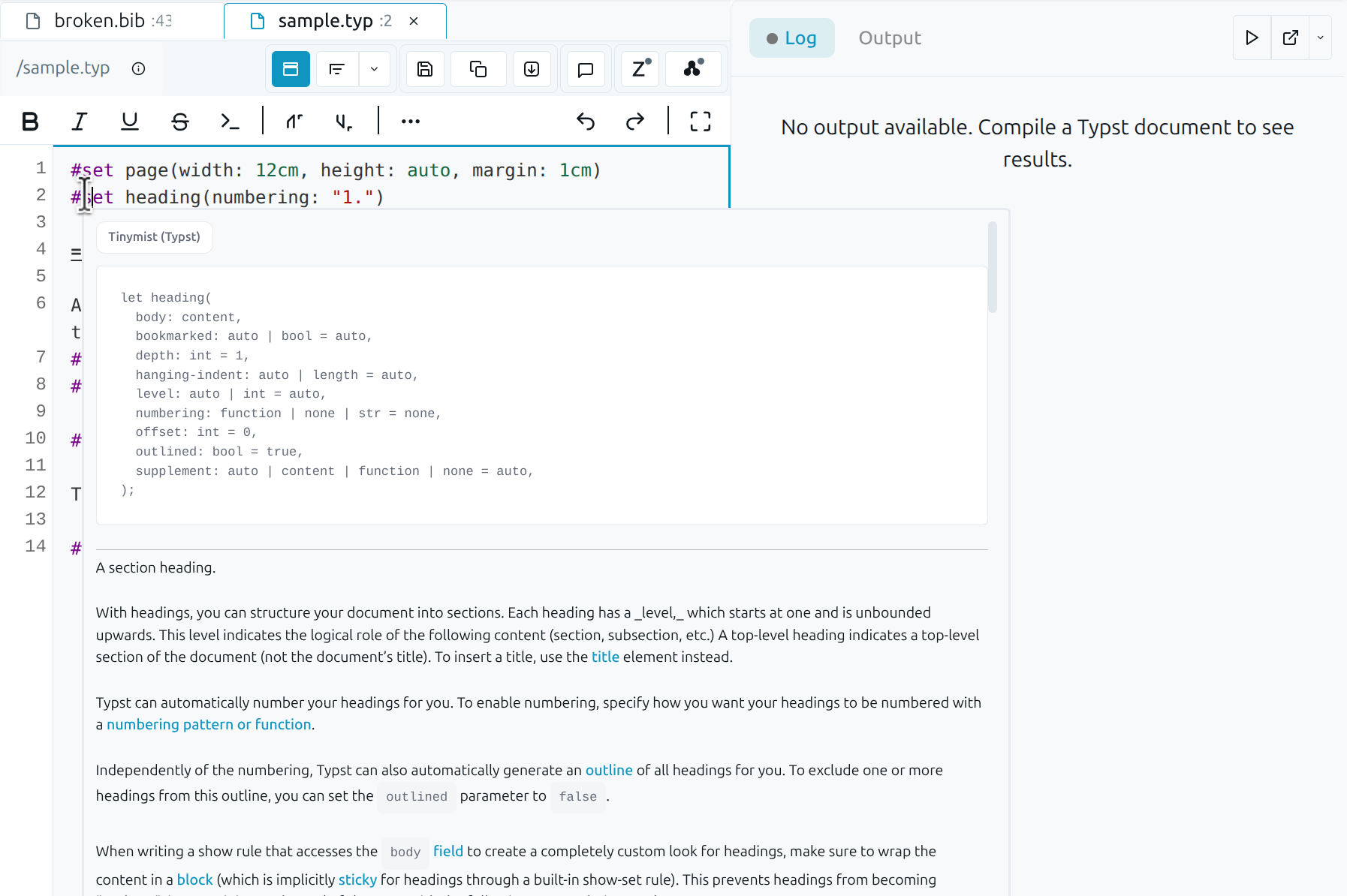
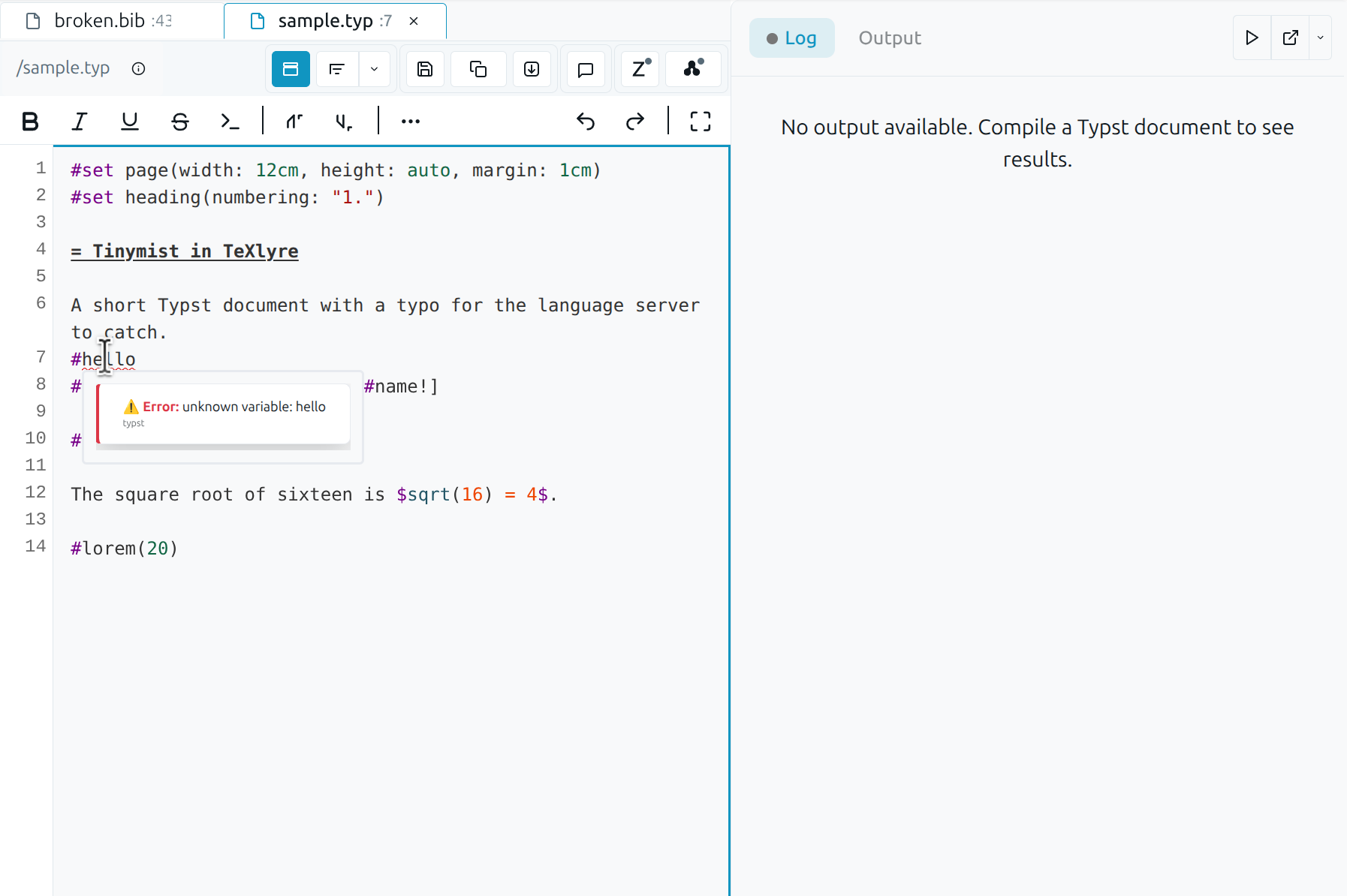
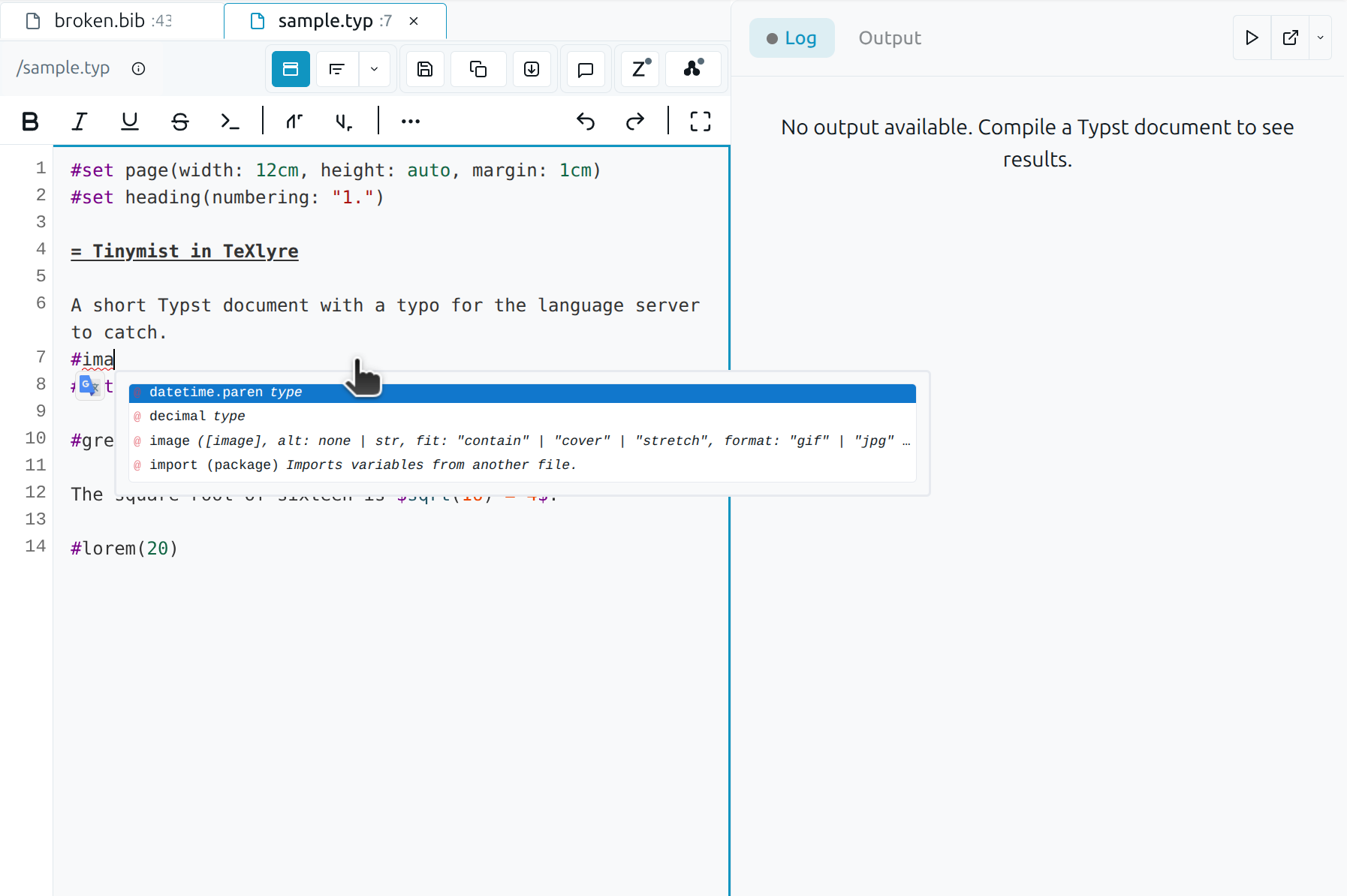
TeXlyre LSP autocomplete

TeXlyre LSP info on hover

TeXlyre LSP info on hover

A request originating in the TeXlyre editor travels over the local WebSocket to Chelys, which forwards it to the language server process and returns the response along the same path.

Milestone 2b: Standalone passkey login and cross-instance local storage sync

TeXlyre already synchronized project data between instances over WebRTC, scoped by project links. Logging in with the Chelys passkey extends this to user-level data. The passkey's PRF output derives a room identifier, and two TeXlyre instances signed in with the same passkey exchange their local storage (settings, properties, records, and secrets) over that room. This runs in the browser over WebRTC and does not require Chelys. The Chelys app remains responsible for installing and running the plugins.

Signaling requires connectivity

The storage exchange relies on WebRTC for peer connections, which by default uses the signaling server at ywebrtc.texlyre.org. Paired instances therefore cannot exchange data while offline. To run fully offline, host a local y-webrtc signaling server (see texlyre-infrastructure) and set its endpoint in both TeXlyre and Chelys.

The room is derived from the user's username, password, and the WebAuthn/PRF passkey, and credentials are stored in the operating system's native keychain. Synchronization uses Yjs CRDTs over WebRTC with no central server holding the data, and a presence indicator shows which devices are connected.

Paired TeXlyre instances exchanging local storage

Once paired, instances share an encrypted account room and exchange local storage over WebRTC; the presence indicator reflects the devices currently connected.

Milestone 4a: Provider plugin system

Providers are packaged as recipes: declarative descriptions of a background tool and how to run it. The plugin system installs, updates, and removes provider containers and resolves their dependencies, so adding a language server does not require manual software setup. A recipe runs either as a native system process or inside a Docker container; Docker mode requires a Docker installation available on the system. Ready-made recipes are published at chelys-recipes, covering Tinymist for Typst, ltex-ls-plus and harper-ls for prose and grammar checking, and JabRef for BibTeX.

Bridging a TCP-only server: JabRef

Most recipes run a language server that communicates through LSP over standard input and output. JabRef's language server, However, jabls only transports over a TCP socket. The recipe runs jabls as a local TCP server and bridges it to a WebSocket that TeXlyre can reach, using socat to connect the TCP socket to standard streams and lsp-ws-proxy to expose those streams as a WebSocket:

TeXlyre ⇄ WebSocket ⇄ lsp-ws-proxy ⇄ stdio ⇄ socat ⇄ TCP ⇄ jabls -p 2087

jabls is the same component that supports JabRef's official VS Code extension, run standalone here and bridged to TeXlyre. It provides BibTeX and BibLaTeX integrity diagnostics for .bib files, reporting consistency, citation-key, and formatting problems as the file is edited. The diagnostics are read-only integrity checks and the server does not modify the .bib file.

The recipe exposes a single user-editable variable, wsPort (default 7021), the port the WebSocket proxy listens on. The internal jabls TCP port is fixed at 2087 inside the container and is not exposed. Changing wsPort updates the run command, the Docker port mapping, and the transport URL that Chelys injects into TeXlyre. The recipe supports three modes: Docker, which builds a self-contained image bundling Java 21, JBang, socat, and the proxy; System, which runs the same bridge from a host toolchain; and Connect, which attaches to a bridge already listening on wsPort. All modes transmit the LSP json recipe for that plugin to TeXlyre over WebRTC.

Walkthrough: from pairing to live diagnostics

The following steps walk through the install to live diagnostics from a local language server, using JabRef as the example provider.

  1. Download and install Chelys for your platform from the v0.1.0 release.

  2. In TeXlyre, register a passkey for Chelys at texlyre.org/texlyre and copy the resulting PRF key.

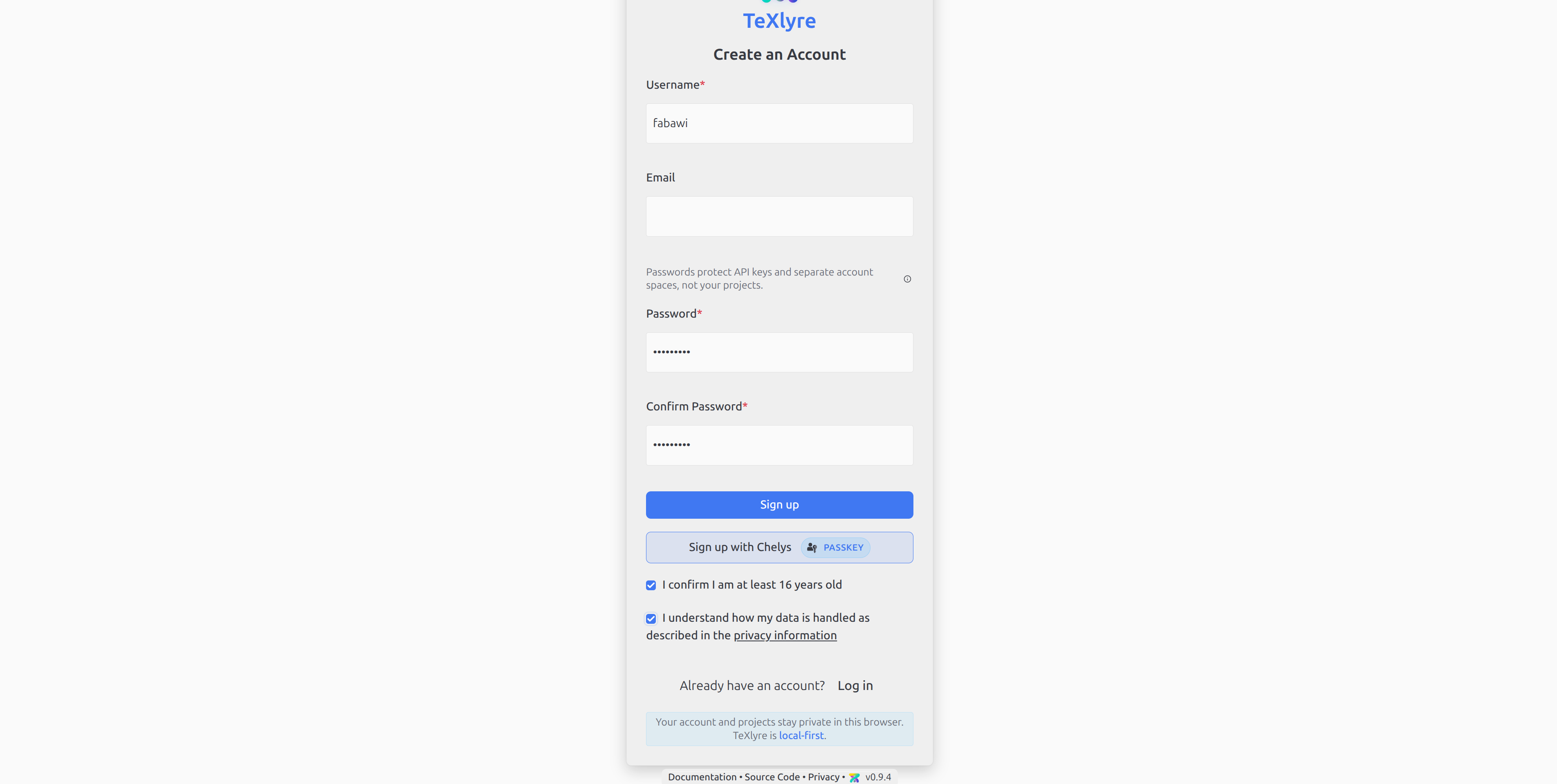
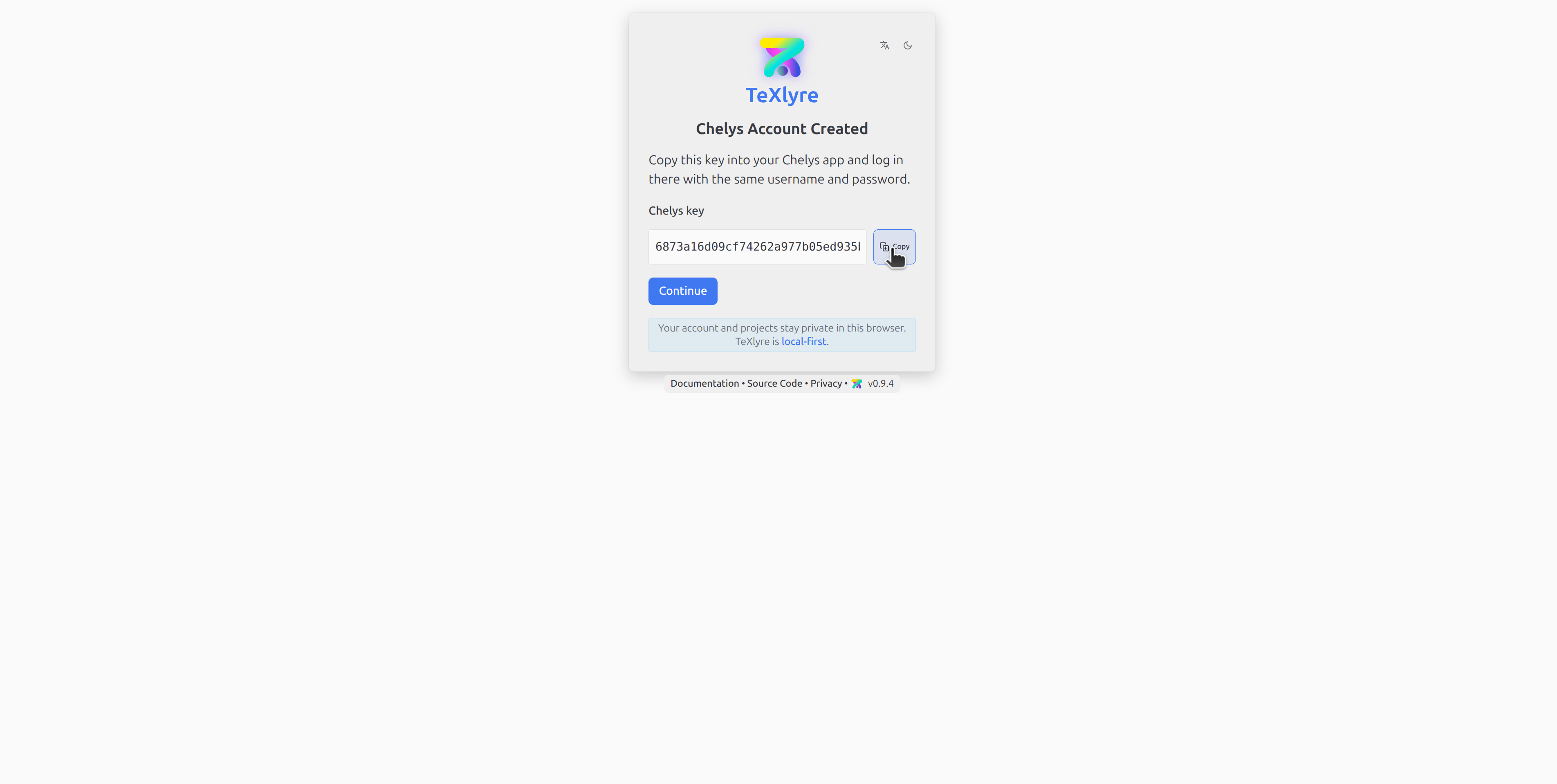
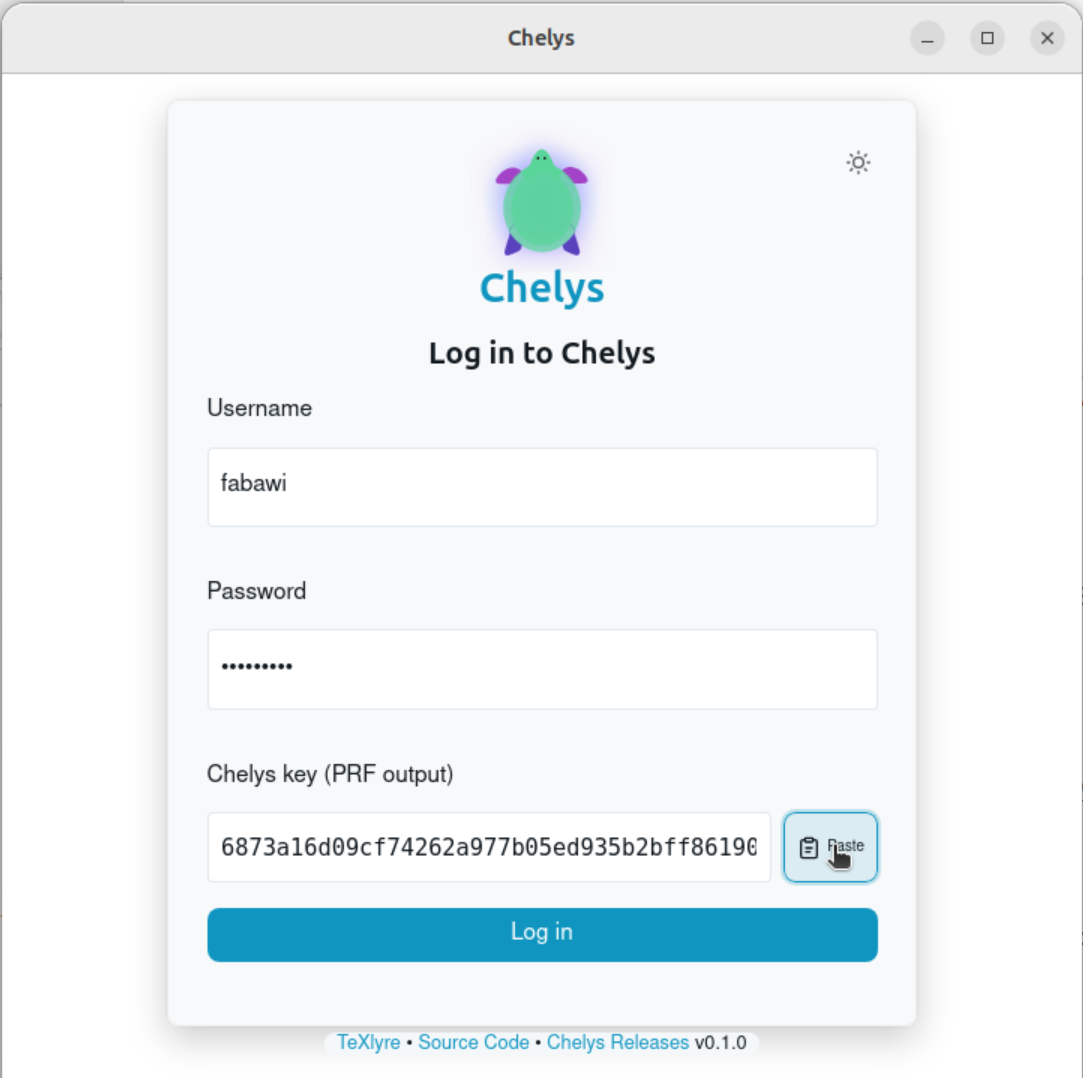
    Registering a Chelys passkey in TeXlyre

    Copying PRF in TeXlyre

    TeXlyre generates a WebAuthn/PRF passkey for Chelys; the PRF key shown here is copied into Chelys to derive the shared account room.

  3. In Chelys, log in with the same username and password and paste the copied PRF key.

    Logging in to Chelys with the TeXlyre credentials and PRF key

    Chelys pairs with the existing TeXlyre identity; credentials are stored in the system keychain.

  4. In Chelys, open Browse recipes and add one of the provided recipes.

    Browsing a recipe in Chelys

    The recipe browser lists available providers; adding one prepares it to be installed as either a system process or a Docker container.

  5. With the recipe added, click Install and choose Docker container.

    Installing the JabRef recipe as a Docker container

    Installing a recipe in Docker mode; the plugin system builds the image and resolves its dependencies.

  6. Once installation succeeds, click Run.

  7. Back in TeXlyre, refresh texlyre.org/texlyre and open a document matched to the running language server, for example a .bib document when running JabRef.

  8. Edit a BibTeX entry and introduce an integrity problem, such as a duplicate citation key or a malformed fields:

    @article{knuth1984,
    author = {Donald E. Knuth},
    title = {Literate Programming},
    journal = {The Computer Journal},
    year = {1984},
    volume = {27},
    number = {2},
    pages = {97--111}
    }

    @article{knuth1984,
    author = {Leslie Lamport},
    title = {LaTeX: A Document Preparation System},
    year = {1986}
    }

    @book{goossens1993
    author = {Michel Goossens and Frank Mittelbach and Alexander Samarin},
    title = {The LaTeX Companion},
    publisher = {Addison-Wesley},
    year = {1993},
    }

    @article{lamport1994,
    author = {Leslie Lamport}
    title = {LaTeX: A Document Preparation System},
    journal = {Addison-Wesley},
    year = {nineteen ninety-four},
    }

    @inproceedings{,
    author = {Jane Doe},
    title = {An Untitled Contribution},
    booktitle = {Proceedings of Nowhere},
    year = {2020}
    }

    @misc{oren2021,
    author = {Oren Patashnik},
    title = {BibTeXing},
    Year = {1988},
    url = {https://example.org/bibtex}
    }

    With jabls running, the issue is underlined as a diagnostic, and hovering or clicking it shows the reported problem.

    Live BibTeX diagnostics from jabls in the TeXlyre editor

    Diagnostics produced by the local jabls server, relayed through Chelys, appear inline in the TeXlyre editor.

Acknowledgements

This work was funded by NLnet Foundation as part of the TeXlyre project.
LaTeX WebAssembly Engine Modernization

· 6 min read
Fares Abawi
TeXlyre author & maintainer
Part of the NGI0 Core roadmap

This post reports on Task 1 of TeXlyre's NGI0 Commons grant. For the full project roadmap, see TeXlyre joins NGI0 Commons.

TeXlyre's in-browser LaTeX compilation has been upgraded from TeX Live 2020 to TeX Live 2026. LuaLaTeX now works alongside pdfLaTeX and XeLaTeX, and SyncTeX provides bidirectional navigation between source and PDF.

Background

TeXlyre originally used SwiftLaTeX, whose WebAssembly build was frozen at TeX Live 2020. This meant any LaTeX package released after 2020 would fail to compile in the browser, and LuaLaTeX was unavailable at all. Bundling a full TeX Live installation into the browser wasn't practical due to size, so we took inspiration from SwiftLaTeX's approach: a dedicated package server that serves individual packages on demand, paired with a modernized BusyTeX WebAssembly engine.

The work spans three repositories that together form the engine stack. Each link below goes to the full diff for that repository's contribution to this task.

Milestone 1a: Dynamic package downloading

Rather than bundling all required TeX Live collections into the WASM image as was previously done in BusyTeX, packages are now fetched from a dedicated TeX Live package server (see the texlyre-busytex-build diff for the server and kpse resolver implementation). A remote kpse resolver bridges the WebAssembly filesystem to the server, so when the engine requests a package during compilation, it's fetched, cached client-side, and served locally on subsequent runs. Cache misses are tracked explicitly to avoid redundant downloads, and ZIP-packaged collections are supported for environments where bulk loading is needed.

Integration with the application layer (engine selection, lazy loading, and cache handling) is in the texlyre and texlyre-busytex diffs.

Packages outside the bundled core are now fetched on demand, making any CTAN package available without rebuilding the engine or the bundle data.

Milestone 1b: LuaLaTeX and modern package compatibility

BusyTeX now builds against TeX Live 2026, with LuaTeX (LuaHBTeX) supported alongside pdfTeX and XeTeX. Multi-engine hyphenation generation and WASM format file rebuilding were both needed to make the new engines work properly across different languages. The build system changes are in the texlyre-busytex-build diff; the engine and multi-tool selection interface is in the texlyre-busytex diff.

Each of the three examples below targets a different capability or package introduced after TeX Live 2020: modern cross-referencing, accessibility tagging, and key-value table syntax

Cross-referencing with zref-clever

zref-clever is a cross-referencing package released on CTAN in 2022 and was not yet available in TeX Live 2020.

\documentclass{article}
\usepackage{zref-clever}
\usepackage{amsmath}

\begin{document}
\section{Introduction}\label{sec:intro}
\section{Equations}\label{sec:eq}
\begin{equation}\label{eq:pythagoras} a^2 + b^2 = c^2 \end{equation}
\begin{equation}\label{eq:euler} e^{i\pi} + 1 = 0 \end{equation}

\section{References}
See \zcref{sec:intro}.
See \zcref{eq:pythagoras,eq:euler}.
See \zcref{sec:intro,eq:pythagoras,sec:eq}.
\end{document}

Output, identical across pdflatex, lualatex, and xelatex:

See section 1. See equations (1) and (2). See sections 1 and 2 and equation (1).

zref-clever correctly groups the two section references together, separates the equation, and joins them with "and".

Accessibility and math tagging with ltx-talk

ltx-talk is a presentation class that uses LaTeX's \DocumentMetadata interface and the tagging pipeline to produce a structurally tagged PDF, including math content. This only compiles with full tagging capability under LuaLaTeX, which is itself the reason Milestone 1b was necessary, since prior to this upgrade, TeXlyre had no LuaLaTeX engine support.

\DocumentMetadata{tagging = on}
\documentclass{ltx-talk}

\IfFontExistsTF{Pennstander-Regular.otf}{
\setmainfont{Pennstander-Regular.otf}
\setmathfont{PennstanderMath-Regular.otf}
}{}

\begin{document}
\begin{frame}
\frametitle{Tagged math in the browser}
\[
\int_0^1 x^2 \, dx = \frac{1}{3}
\]
\end{frame}
\end{document}

The resulting PDF carries structural tags for both text and math, readable by screen readers and other assistive tools. Authoring accessible documents is now possible directly from the browser instead of requiring a local TeX installation.

Modern tables with tabularray

tabularray (first CTAN release in 2021) replaces tabular's positional column specifiers with a key-value syntax. It compiles under all three engines.

\documentclass{article}
\usepackage{xcolor}
\usepackage{tabularray}

\begin{document}
\begin{tblr}{
colspec = {Q[c] Q[c] Q[r]},
row{1} = {bg=gray!20, font=\bfseries},
hlines
}
Engine & Year & Status \\
pdfTeX & 2026 & Supported \\
LuaTeX & 2026 & Supported \\
XeTeX & 2026 & Supported \\
\end{tblr}
\end{document}

All dependencies (tabularray, xcolor, ninecolors, and their transitive requirements) are resolved at compile time via the on-demand package server.

Milestone 1c: SyncTeX bidirectional navigation

SyncTeX is implemented across three layers, with one diff per layer:

  • Engine layer (texlyre-busytex-build diff): SyncTeX generation enabled in the BusyTeX build, producing .synctex.gz output alongside the PDF.
  • API layer (texlyre-busytex diff): an interface for extracting the SyncTeX file within a compilation session.
  • UI layer (texlyre diff): a SyncTeX parser and source map service that decode the SyncTeX data into coordinates usable by the editor.It supports forward navigation (click in source, highlight in PDF) and reverse navigation (click in PDF, cursor jumps to source), integrated with both the PDF.js renderer and the canvas renderer.

SyncTeX source-to-PDF highlighting

SyncTeX forward navigation (only supported with BusyTeX engines): clicking the target button or double clicking in the source editor highlights the corresponding region in the rendered PDF.

Acknowledgements

This work was funded by NLnet Foundation as part of the TeXlyre project.